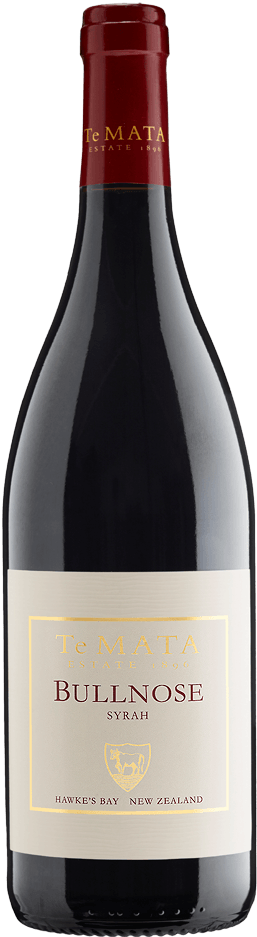
Te Mata
Bullnose Syrah, Hawke’s Bay
First planted in 1990, the Bullnose Vineyard’s old red iron soils produce Te Mata Estate’s finest Syrah. These are New Zealand’s second oldest plantings of Syrah. This vineyard is blended with fruit from Te Mata’s Isosceles and Hotspur Vineyards, which add structure and acidity to the finished wine. The wine is named Bullnose after an early Morris Cowley car, which was nicknamed Bullnose due to its distinctive radiator. The bull emblem that appears on the wine label is drawn from the car’s radiator crest.
Separate parcels of fully ripened syrah grapes were hand-harvested from Te Mata Estate’s Bullnose, Isosceles and Hotspur Vineyards, which lie within the Gimblett Gravels and Pridge PA Triangle subregions of Hawke’s Bay.
- Region
- Hawke's Bay
- Appellation
- Hawke's Bay
- Varietal Composition
- Syrah
- Aging
- 11 months in new and seasoned French oak barrels (33% new oak).
- Alcohol
- 13.5%
The Bullnose Syrah shows its signature vibrant magenta hue with a purple rim and an expressive nose of dianthus, freesia, raspberry, black cherry, and hints of cola. The rich, plush palate mirrors the concentrated berry fruit, supported by superfine tannins and a refined, refreshing finish. Elegant and fragrant, it balances depth and modern precision with hallmark Bullnose finesse.
Vinous
93 Points
2021
“Exotically spiced, leaving you half expecting a belly dancer to appear while you're drinking it. It is sweetly fruited while full of floral fragrance, cardamom, cinnamon and sandalwood. While it is richly fruited, it is not a big Syrah in terms of size. It does, however have motion and drive; the tannins are well-handled. Fragrant and long with sinew providing length and carrying its scent.”
— Rebecca Gibb, 2023
Wine Spectator
91 Points
2021
"Shows dense notes of salted black licorice and black cherry, with touches of date nut bread, cinnamon and fresh tobacco. Details of rosemary and sage create a wonderfully complex, detailed red, with a long, expressive finish. Drink now. 3,000 cases made, 300 cases imported."
— MaryAnn Worobiec, 2025